


 Columns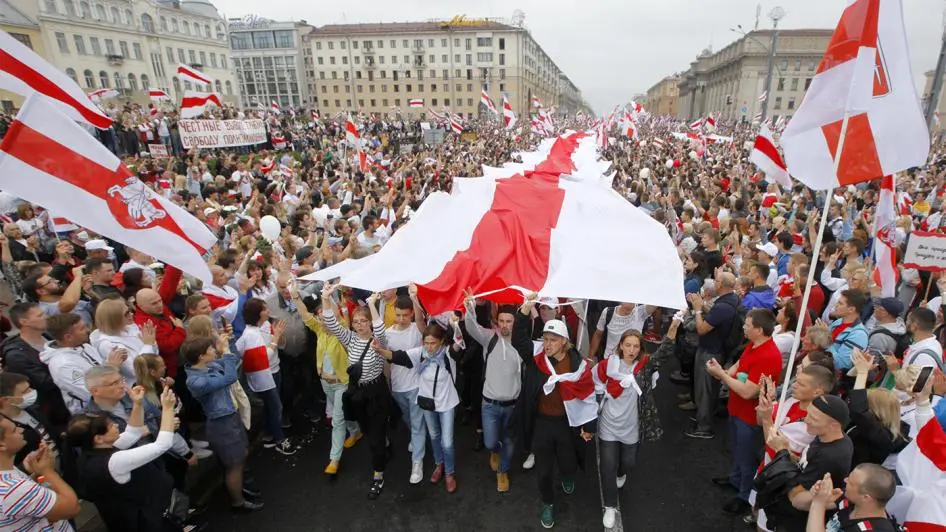
Originally published on The Ukrainian Weekly
Five years ago on August 9, 2020, Belarusian dictator Alyaksandr Lukashenka was pronounced winner of a sixth term in what were clearly rigged elections. The real winner was the main opposition candidate, Sviatlana Tsikhanouskaya. The widespread and flagrant vote fraud triggered huge street protests. These weekly protests, usually held on Sundays, often exceeded 100,000 people, which is a remarkable number for a country of 9 million people.
As a policy advisor at the Commission on Security and Cooperation in Europe (OSCE, also known as the Helsinki Commission), I served as an official U.S. government observer for the OSCE in eight of the nine national elections from 2001 to 2017. (The one election I missed was because the Belarusian authorities refused to grant me a visa, despite diplomatic protests from the U.S. State Department and the OSCE.)
Given my experiences observing elections in Belarus, I was not in the least surprised that the August 9, 2020, elections were neither free nor fair – that was par for the course. But I was astounded at the numbers of Belarusians who turned out to protest in the aftermath of the elections.
In my eight Belarus election observation experiences, I witnessed protests following each of the fraudulent presidential and parliamentary elections – some larger, some smaller, some more harshly repressed, others less so. In the last two post-election protests I saw in 2015 and 2016, the crowds were meagre. After all, the democratic forces and civil society had been worn down by decades of oppression, including a brutal crackdown following the 2010 presidential election. So, the massive outpouring of support for democracy in August 2020 came out of the blue for me and most Belarus watchers. It was a testament to the notion that a people’s desire for freedom cannot be extinguished.
The 2020 mass, peaceful demonstrations lasted for months, despite a harsh crackdown that included torture, abductions and the imprisonment of tens of thousands of people. Hundreds of thousands more fled the country. Ultimately, the protestors were no match for an apparatus of repression that had been honing its skills since 1994, when Mr. Lukashenka first assumed power.
Over the last 5 years, more than 5,000 people have been convicted on politically motivated charges, and some 1,200 remain imprisoned. Among the imprisoned are hundreds of people who were arrested for supporting Ukraine in its fight against Russian aggression. Belarus has perhaps the highest, if not one of the highest, numbers of political prisoners per capita in the world.
Not surprisingly, dictator Lukashenka is one of Vladimir Putin’s closest allies and has long relied on subsidies from Moscow to prop up his unreformed economy. After the 2022 full-scale Russian invasion of Ukraine, which the Lukashenka regime supported, Belarus has become more isolated and dependent on Russia. The country was used as a staging ground for Russian troops in their full-scale assault on Ukraine. But the Belarusian authorities have colluded with Moscow in other ways, including their involvement in the forced displacement and indoctrination of Ukrainian children from Russian-occupied territories.
As a result of my work on Belarus at the Helsinki Commission and as a Ukrainian American, I have a great affinity for Belarus and its people, who share more with Ukraine historically, linguistically and culturally than any other nation. Belarusians continue to suffer under Mr. Lukashenka’s dictatorial rule. Living under an anti-democratic regime that has suppressed their human rights and fundamental freedoms for three decades has not stopped their yearning for freedom and genuine independence.
I have tremendous admiration for the democratic opposition, members of civil society and human rights defenders, many of whom I have known over the years. Their courage in the face of unrelenting repression has been deeply inspiring.
Belarusian democrats have been resolutely pro-Ukrainian and the Belarusian opposition in exile has vociferously supported Ukraine. They understand perfectly well that Belarus’ freedom and Ukraine’s freedom are inextricably linked. Moreover, thousands of Belarusians have fought on Ukraine’s side in the war, many in the Kalinouski regiment. At least 65 have died. More than 41 individuals have been convicted in Belarus for making financial contributions to the Kalinouski regiment, and 30 have received jail time for the “intention to fight” on the side of Ukraine.
Other forms of resistance include Belarusian hackers, who not only target the Lukashenka regime but also Russia itself. On July 28, for instance, the Belarusian Cyber Partisans, working with the Ukrainian group Silent Crow, attacked the Russian state airline Aeroflot, forcing the cancellation of numerous flights.
The Belarusian people in general are opposed to the war. This is the main reason that Mr. Lukashenka has never sent the Belarusian military to fight alongside the Russians in Ukraine. Even he knows that this would be too much for the Belarusian people.
It is a big mistake to conflate the Lukashenka regime with the long-suffering Belarusian people, who want no part of this war and would prefer to be rid of the Lukashenka dictatorship. They recognize and reject that Belarus has become in recent years, for all practical purposes, a vassal state of Russia.
High on the agenda of the democratic opposition and international organizations, such as the United Nations, the OSCE and the European Union, is the plight of some 1,200 political prisoners. Conditions in Belarusian prisons are inhumane, with the unjustly imprisoned enduring torture and abuse. They are subject to incommunicado isolation, extreme overcrowding, exposure to extreme cold, severe weight loss, lack of proper medical treatment, denial of access to family, lawyers and meetings of worship and clergy visits, as well as other violations of international human rights standards and basic human dignity.
Among the 1,200 are long time human rights advocate Ales Bialiatski, who along with Ukraine’s Center for Civil Liberties (Oleksandra Matviichuk) and Russia’s Memorial, is a 2022 Nobel Peace Prize laureate.
The United States has engaged with the Belarusian government to release political prisoners. Following a meeting in Minsk in June between Mr. Lukashenka and Gen. Keith Kellogg, U.S. President Donald Trump’s envoy for Ukraine, six political prisoners were released, most notably Siarhei Tsikhanouski, the husband of the leader of Belarus’ democratic forces in exile, Sviatlana Tsikhanouskaya.
While everyone in the democratic opposition is concerned about the plight of political prisoners, some have prioritized their release, believing in the possibility of engaging in negotiations with the Lukashenka regime. Others advocate for continued strong international pressure, including sanctions, and see prisoner releases as simply tactical moves by the regime designed to soften sanctions.
Yet the number of political prisoners has increased this year, despite seven waves of “pardons” since the beginning of the year and the deal with the U.S. Recent weeks have seen trials of those who joined in the 2020 protests (based on archived video footage, social media and informants’ reports) because the statute of limitations for participating in them will soon expire.
Hopefully, Mr. Lukashenka will release more political prisoners and soften, even if ever so slightly, his assault on civil society, which has always faced pressure but that his regime has now basically dismantled. Given my own experience following developments in Belarus since 1995, I long ago reached the conclusion that Mr. Lukashenka is constitutionally incapable of fundamental reform. He may, for tactical reasons, marginally ease up on repression, but he will not change his stripes and embrace democracy or respect human rights – that much is for certain. As long as the Belarusian dictator remains in power, and as long as he remains servile to an imperialistic, autocratic Russia, Belarus will not be free.