


 Columns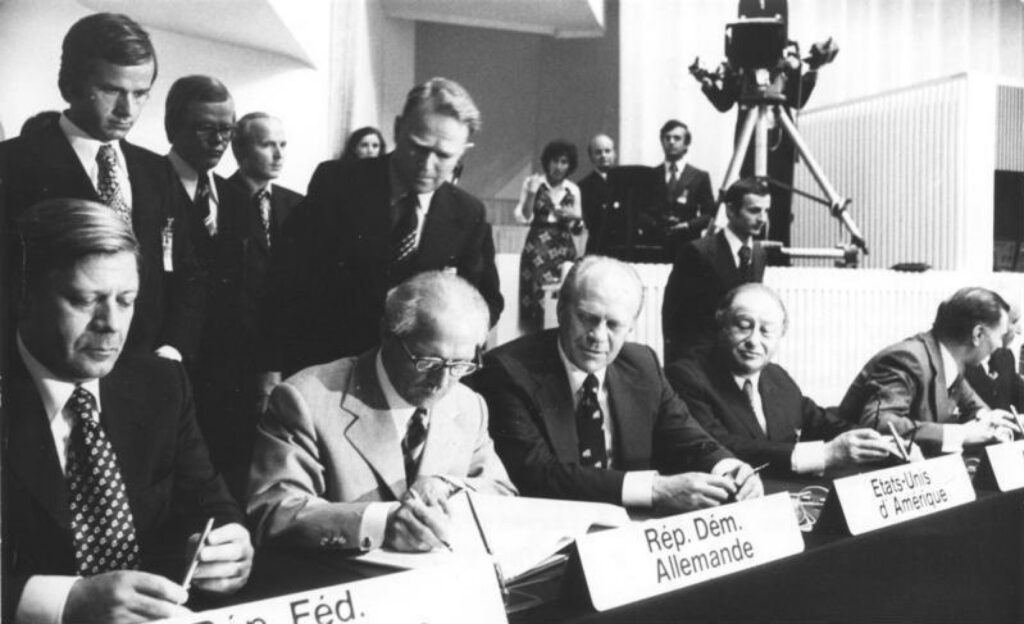
Originally published on The Ukrainian Weekly
Although it might not have seemed evident at the time, August 1, 1975, was a milestone date in the history of Europe and, indeed, the world. Following three years of negotiations, the leaders of 35 countries, including U.S. President Gerald Ford and Soviet leader Leonid Brezhnev, signed the Final Act of the Conference on Security and Cooperation in Europe (the Helsinki Final Act). The Final Act has turned out to be one of the most consequential political agreements of the post-World War II era. Its signing marked a turning point for Ukraine and other captive nations within the Soviet empire.
Initially, the Final Act’s signing was met with some negative reaction within the United States, as it recognized the post-World War II territorial status quo. It was seen as solidifying Moscow’s hold over the captive nations. But the Final Act included human rights language that the Soviets reluctantly accepted but didn’t think would matter that much. They were sorely mistaken, as the human rights provisions turned out to be a trojan horse that led to the demise of the Soviet empire.
The Final Act addressed security, economic and humanitarian concerns designed to reduce tensions and promote cooperation between the West and the Soviet-dominated East. The Act’s 10 core guiding principles included territorial integrity, sovereign equality and the inviolability of frontiers. Yet it defined security not only in military terms, but in a unique, comprehensive manner that included respect for human rights and fundamental freedoms among its guiding principles. This emphasis on human rights empowered dissidents in the Soviet Union and Eastern Europe to press for greater rights and freedoms.
Following the Helsinki agreement, citizens’ groups sprang up in the Soviet Union and other Warsaw Pact countries to monitor and encourage their governments to live up to their freely undertaken Helsinki Final Act commitments. The largest of the five Soviet groups (Moscow, Ukrainian, Lithuanian, Georgian and Armenian) was the Ukrainian Helsinki Monitoring Group (UHG). Its members peacefully advocated not only for greater individual rights and freedoms, chronicling many individual violations, but also for greater cultural and linguistic freedoms and self-determination. Thus, they constituted a particular threat to the Soviet regime and were harshly repressed.
The Helsinki Final Act and the suppression of dissidents spurred the U.S. to greater engagement on human rights in the region. Within a year of the Final Act’s signing, Congress created the Commission on Security and Cooperation in Europe (the Helsinki Commission). This was an independent U.S. government agency, consisting mostly of Senators and House members, Democrats and Republicans, but also included representatives from the U.S. State, Defense and Commerce departments. The mandate of the commission was to monitor and encourage compliance with the Helsinki Final Act and subsequent agreements by all signatory states. This included promoting basic human rights and freedoms, and defending those persecuted for acting on their rights and freedoms. It also included ensuring that Helsinki Final Act principles were given full consideration in U.S. foreign policy, which sometimes meant encouraging the State Department to be more proactive.
Institutionally, the creation of the commission proved to be instrumental in focusing attention on human rights in the Soviet Union and Warsaw Pact countries. The activities of the commission raised the profile of Ukraine and other captive nations by focusing on human rights concerns, including the plight of the Ukrainian Helsinki Monitoring Group and the then-banned Ukrainian Catholic and Orthodox churches, along with many other human rights issues. (I was privileged to serve as a professional staff member/policy advisor at the Helsinki Commission for more than 35 years both during and following the Cold War, from 1981 to 2017.)
Crucially, the Helsinki Final Act specifically provided for follow-up meetings to review the implementation of its provisions. These meetings became known as the Helsinki process of the Conference on Security and Cooperation in Europe. They proved vital for monitoring compliance with the Final Act, especially on human rights issues, and for keeping the lines of communication open between the West and East. Multiyear conferences of the 35 signatory states were held in Belgrade (1977-78), Madrid (1980-83) and Vienna (1986-1989), as well as meetings of limited duration in Budapest, Ottawa, Bern, Paris, Copenhagen and Moscow throughout the 1980s and early 1990s. These gatherings were the principal diplomatic vehicle for calling out the Soviet Union and its allies for their egregious suppression of rights and freedoms.
The Helsinki process paid considerable attention to the human rights situation in Ukraine, including to the repressed members of the Ukrainian Helsinki Group (UHG) and other Ukrainian prisoners of conscience. Following their releases from the Gulag in the late 1980s, veterans of the Helsinki movement, among them Viacheslav Chornovil, Mykhaylo Horyn and Levko Lukianenko, were instrumental in laying the groundwork for Ukraine’s independence.
Working at the Helsinki Commission gave me the opportunity to participate as a member of the United States delegation to each of these conferences and meetings except for Belgrade. I saw first-hand their value as a platform for the United States, first and foremost, and our Canadian and European allies to press for implementation of human rights and other “human dimension” obligations. This included “naming names” – raising specific cases of those unjustly imprisoned or otherwise repressed, which was not customary at diplomatic conferences.
The Soviets and their allies did not appreciate this focus on their violations, including specific cases, to put it mildly. But this consistent and persistent pressure to hold them accountable for their behavior, coupled with a willingness by the West to engage on matters of mutual security interests, helped produce a shift in Soviet behavior in the direction of greater freedoms. This in turn greatly contributed to the end of Soviet control over Eastern Europe, the demise of the Soviet Union and independence for Ukraine, the Baltic States and other Soviet republics.
Following the collapse of the Soviet empire, the Helsinki process (CSCE) successfully adapted to the post-Cold War environment, becoming the Organization for Security and Cooperation in Europe (OSCE). With the creation of many new states, the organization’s membership expanded from 35 to 57 countries. The OSCE has become the largest regional organization in the world, promoting security, democracy and various forms of cooperation in a myriad of constructive ways for the last three decades.
Unfortunately, the OSCE is now in turmoil, and its ability to help maintain the rules-based international order is in question.
This in large part is due to Moscow’s worsening obstructionism of the OSCE. But the primary factor is Russia’s brutal war of aggression against Ukraine, which violates every single one of the OSCE’s 10 core principles enshrined in the Final Act, and which the vast majority of the 57 OSCE countries resolutely condemn. Indeed, Ukrainians are literally on the front lines fighting for these Helsinki principles.
Irrespective of what OSCE’s future holds, there is no doubt that the Final Act marked a turning point in the advancement of human rights and freedom. Russian President Vladimir Putin, who is accused of committing war crimes, is doing his best to reverse historic transformations that the Final Act expedited and to restore the Soviet/Russian empire. Ultimately, he will fail, and the noble goals of peace, freedom and human dignity embodied in the Helsinki Final Act will prevail.