


 Columns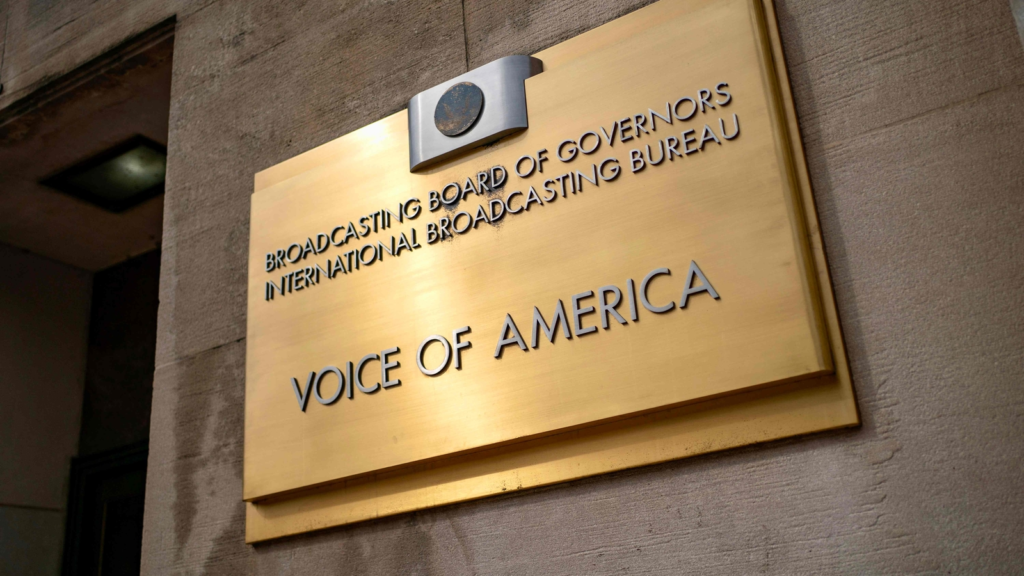
Originally published on Vilni Media
It’s Shocking. Horrific. Painful. It’s not in the interests of the people of the United States and, certainly, not in the interests of democracy, freedom and independent journalism around the globe. Those are just a few of my initial feelings about the Trump Administration’s decision to suspend the operations of the Voice of America (VOA), placing 1300 journalists on administrative leave while it ponders the future of the agency.
The Voice of America was not created to be an international press office of the President of the United States or his or her political party. Instead, it is a media organization designed to explain to foreign audiences America’s politics, values, societal trends and engagement with the world. For half a century the Voice of America’s mission has been defined by the VOA Charter, which was passed by Congress and signed into law by President Ford in 1976.
The charter begins with the words: “The long-range interests of the United States are served by communicating directly with the peoples of the world”– initially via radio and subsequently also through TV and the Internet. Besides underscoring VOA’s role as a source of authoritative, accurate, objective and comprehensive news, the charter also emphasizes the agency’s role in the “projection of significant American thought and institutions” and in clearly and effectively presenting U.S. policies and “responsible discussions and opinion” on those policies.
By adhering to these principles of journalistic excellence, VOA’s audience has continued to grow and the most recent data show that it has been reaching over 350 million people across various media platforms in over 40 different languages in any given week.
The sudden silencing of America’s voice is part of broader crippling by the Trump team of a number of America’s “soft power” institutions – including the U.S. Agency for International Development, the National Endowment for Democracy, the Fulbright Program and VOA’s sister media organization – Radio Free Europe/Radio Liberty. All are being brazenly dismantled with incredible speed and callousness.
These actions are supposedly being taken to improve government efficiency and in the name of reforming outdated systems and practices. But from my perspective as a former journalist and manager in the Ukrainian Service of the Voice of America, there is a precedent for implementing changes without doing irreparable damage to the mission and the institution.
During his presidency in the 1990s, Bill Clinton launched a big program of “Reinventing Government” which, in consultation with Congress and the various federal departments, reduced the size of government by 426,000 positions in the span of seven years. That figure comes from a recent National Public Radio story comparing the work of Elon Musk’s DOGE with the government reform and streamlining efforts undertaken decades ago.
And what was the impact those Clinton-era cuts on the Ukrainian Service of VOA? A few people retired or transferred to other government agencies and some reduction in broadcasting to Ukraine took place — but the Service (and all of VOA) continued to energetically and successfully carry out its mission without interruption. And truth be told, as is the case for any media organization, VOA Ukrainian has always been in the process of adapting to political, technological and market changes — transitioning from radio to TV to online formats and responding to the deepening of US-Ukraine relations from the early days of Independence to the Orange Revolution to the Euromaidan and Russia’s war against Ukraine. So, keeping in mind the Clinton-Gore experience of actually trying to improve the government, not break it — why can’t VOA Ukrainian’s operations continue today while the Trump team carries out its so-called efficiency reforms? It’s not a rational approach unless, in fact, you’re trying to disband the teams of experienced and respected journalists in dozens of language services that enable VOA to successfully carry out its global mission.
Some might say that in this day and age, VOA is no longer needed. Some billionaire “tech bros” would argue that you can find all the news and information you need on X or Facebook, where anyone can be a journalist or commentator. They often characterize it as pure democracy without gatekeepers.
Although social media has a role to play, I believe that the need for professional news media organizations remains critically important for having an informed public and genuine democratic debate and governance. My simple logic: If you want to be educated, you turn to a professional teacher. When you want to be treated for an illness you go to a professional doctor. And if you want to be a well-informed citizen you turn to professional journalists, who are trained to provide fair and balanced reporting.
When I think about the informational needs of Ukraine’s citizenry, there is so much work ahead for the media in covering possible peace negotiations, the pursuit of justice for the war’s victims, obtaining security guarantees and post-war reconstruction—including the role of the Americans in all of this. It isn’t realistic to expect that Ukraine’s media, with its limited resources, can currently do the job alone. Based on its exemplary coverage over the decades and particularly over the last three years, VOA’s Ukrainian Service would have been well-positioned to play an important role in informing the Ukrainian public about these upcoming challenges, directly or in partnership with Ukrainian media outlets.
Why is the U.S. Administration unilaterally disarming its highly reputable soft power institutions like the Voice of America while adversaries like Russia and China spend gazillions on persuading foreign audiences through disinformation and manipulation? There seems to be something sinister going on here. Congress and the American people must urgently act to reverse the damage that is being done to our soft power institutions which support democracy abroad and our national interests and which have been thoughtfully and pluralistically developed since World War II by America’s political leaders, experts and civil society. It wasn’t so long ago that we were certain we had vanquished Russian imperialism and authoritarianism. Are we really willing to snatch defeat from the jaws of victory? We need the tools to support our democratic allies and civil society around the world. America needs a strong Voice!