


 Columns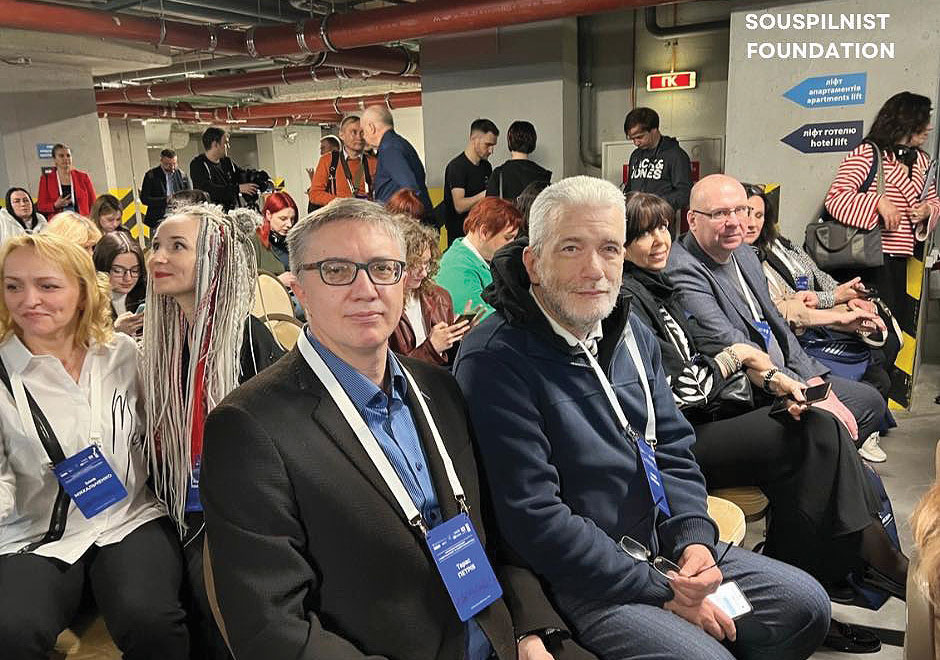
Originally published on The Ukrainian Weekly
WASHINGTON, D.C. – As chroniclers of Vladimir Putin’s full-fledged invasion of their country, Ukrainian journalists have reported on and borne witness to killings, attrocities, war crimes, destruction of civilian infrastructure and other human suffering perpetrated by Russian forces on a large scale. And Ukrainian journalists and newsrooms have themselves been victims of Russia’s aggression.
According to the Kyiv-based Institute of Mass Information, dozens of Ukrainian journalists have been killed, kidnapped, injured, tortured or have disappeared, and more than 230 media outlets have closed or been forced to suspend operations since February 2022.
One of the most influential non-governmental organizations engaged in assisting journalists in Ukraine during wartime is the Souspilnist Foundation.
In an interview with The Ukrainian Weekly, Taras Petriv, president of the foundation, discussed the state of journalism in Ukraine during the war.

“There have been many challenges that have needed a rapid response. … Journalists had to mobilize quickly, some media outlets were left without staff – some journalists went to fight on the front, some relocated with their families to western Ukraine” or abroad, he said.
On the eve of the invasion, the foundation started preparing a network of Ukrainian “fixers” to assist incoming foreign journalists with war coverage in an unfamiliar cultural landscape.
Mr. Petriv said that the collaboration of Ukrainian journalists with their foreign colleagues is a genuine success, resulting in award-winning coverage under extremely dangerous conditions. The Souspilnist Foundation also conducted safety trainings for Ukrainian journalists to prepare them for the dangers of reporting from the front line, and developed an insurance program for them in case of injury or death, an option that had previously not existed.
Mr. Petriv noted that “since 2022, Ukrainian journalists have been witnessing the carnage on the frontlines, the exhumation of bodies after Russian war atrocities in Bucha, [Ukraine], hearing from eyewitnesses and victims of Russian genocidal acts, which has terribly impacted the mental state of journalists.”
And round-the-clock coverage of the war has led to burnout among many media professionals. In response, the foundation created a Mental Support for Media program, which offers extensive mental health consultations by trained psychotherapists to individual journalists or entire newsrooms.
The Souspilnist Foundation will mark its 30th anniversary next year. For the past decade, its signature educational program has been the Media Mobility Hub, which brings journalism students from all around the country to Kyiv for two-week internships with national media outlets.
The hub helps in the formation of a skilled and motivated talent pool for newsrooms in the regions and in the capital. The program also entails discussions with leading journalists and media experts. Over 500 students from some 50 universities have participated to date.
Before the war, some of the typical trainings conducted by the foundation focused on conducting debates, adherence to journalistic standards, media management, multimedia journalism, strategic communications, battling disinformation and media literacy.
The Souspilnist Foundation is a co-founder – along with Detector Media, the Institute of Mass Information, Internews and the Center for Democracy and Rule of Law – of the Independent Media Council (IMC), which has been offering expert opinion on media-related disputes in the country, including whether or not news coverage meets journalistic standards or regarding actions of government officials that may encroach on media freedoms.

In one case, the council provided an in-depth legal analysis that concurred with the government’s argument that its decision to shut down three pro-Russian television channels in Ukraine – controlled by notorious oligarch Viktor Medvedchuk – for national security reasons did not undermine freedom of speech and was legitimate.
In March of 2022, IMC published an open letter providing recommendations to foreign journalists working in Ukraine. Among other suggestions, it urged them to make clear Russia’s role in the war by calling it “Russia’s war in Ukraine” or the “Russian invasion of Ukraine” rather than “Ukraine crisis” or “Ukraine conflict.”
Mr. Petriv said he is also proud of the vigorous work of his Souspilnist Foundation and other like-minded non-governmental organizations in pushing for the transformation of government-controlled radio and television into a public broadcasting entity (“Suspilne movlennia”).
Supporters of public broadcasting saw its creation as crucial to battling the influence of Russia – as well as Ukrainian oligarchs and some officials in Kyiv – on the media market.
“We understood that there needs to be a broadcaster amidst the dominance of oligarchic channels because the authorities very often cooperated with these [media] holdings and influenced them,” he said.
There was a recognition “that there needs to be an informational media or system for distribution of information in Ukraine that will stand up for and defend the public interest,” Mr. Petriv said, adding that public broadcasting today is “a barometer of all freedoms in Ukraine.”
Mr. Petriv, a native of Ivano-Frankivsk, Ukraine, early in his career worked at the Molod Ukrayiny and Holos Ukrayiny newspapers, which were popular in the 1990s. He headed the information service in the administration of President Viktor Yushchenko, during whose term media freedoms greatly expanded in Ukraine.
Besides leading the Sousplilnist Foundation, Mr. Petriv is also an associate professor at the Institute of Journalism at Taras Shevchenko National University in Kyiv.
When asked how the war has impacted his students, he said, “this is a generation that has been forged by the war. … They understand that they will need to write about the war for many years, even after it is over.”
He is impressed by their seriousness, unbreakable resilience and dedication to democracy.
He said that when he asks his students what keeps them in Kyiv during the war, a typical reply is: “First of all, there is work to be done and we need to do it. Secondly, with our presence, we demonstrate to the world what the Ukrainian nation is and where our strength comes from. We are not changing course. And we want to show that we are here with our country and with our people.”
Mr. Petriv observed that his students feel a responsibility for Ukraine’s fate, akin to that of previous generations of freedom fighters, and they fulfill that calling through journalism.
Seeing his students demonstrate such a steadfast commitment to journalistic values and their country validates his decades-long work of supporting journalists and journalism in independent Ukraine.